Aristek SystemsContact Us
background image
background image

AI system architecture services

Yes, AI opens new possibilities, but real impact depends on the system behind it.

We design AI systems and architecture that integrate, scale, and perform reliably.

6+

years of AI dev experience

23+

years in tech

40+

clients worldwide

Icon of Certificate 1Icon of Certificate 2Icon of Certificate 3Icon of Certificate 4Icon of Certificate 5Icon of Certificate 6Icon of Certificate 7Icon of Certificate 8Icon of Certificate 9

What happens after the model is built

You built a strong AI model, a clean interface – and that’s a good start. The challenges appeared later, when AI began interacting with real systems, data, and workflows…

With the right architecture in place, AI becomes part of a stable system – integrated, scalable, and reliable.

What a well-designed AI system looks like:

  • Handles scale and latency predictably
  • Works with messy and incomplete data
  • Fits into existing systems
  • Meets regulatory and security requirements
  • Supports human workflows
  • Recovers from failures gracefully

Where system design becomes the limiting factor:

  • Models do not integrate cleanly
  • Workflows are not designed for AI decisions
  • Data is fragmented or unreliable
  • Performance drops under real load
  • Outputs cannot be evaluated consistently
  • Failures are hard to detect and debug
Image 1
Image 2
Image 3

What AI system architecture involves – and why it’s important

AI system architecture defines how all parts of the system work together: how data flows, how models are orchestrated, and how outputs are evaluated and controlled.

It is not limited to the model itself, but consists of several layers that determine how the system behaves in practice:

  • Orchestration → how models and services work together

    Defines how tasks move between models, services, and workflows, and how decisions are routed across the system.

  • Data pipelines → how data flows through the system

    Define how data is collected, transformed, and delivered to different parts of the system.

  • Retrieval and context → how the system uses relevant information

    Define how context is selected and injected at runtime to support model responses.

  • Evaluation → how outputs are measured

    Defines how results are validated, compared to expectations, and tracked over time.

  • Monitoring → how system behavior is observed

    Defines how performance, errors, and model behavior are tracked in production.

  • Governance → how control and compliance are enforced

    Defines permissions, auditability, and how the system meets security and regulatory requirements.

If your AI system is incomplete, unstable, or hard to scale, we can help structure and improve it.

Our AI architecture services

We design AI systems as a set of connected components. Our work is structured in three stages, which can be delivered independently or extended into a longer collaboration as your system evolves.

  • Define & Architect

    For teams defining how their AI system should work before development begins.

    • End-to-end system architecture (data, models, applications)
    • Service decomposition, system boundaries, and API design
    • AI workflow design (decision flows, multi-step pipelines, human-in-the-loop)
    • Data modeling and retrieval strategy (RAG, context management)
    • Governance design (access control, auditability, compliance structure)
    • Platform architecture (modular design, multi-service systems, extensibility planning)


    Outcome:

    Clear system structure, defined workflows, and a validated architecture ready for implementation.


  • Build & Integrate

    For teams implementing AI systems and bringing them into production.

    • Integration with existing systems (ERP, CRM, LMS, internal platforms), along with implementation of the AI system architecture
    • API orchestration and cross-system data consistency
    • Reliability design (fault tolerance, fallback logic, recovery mechanisms)
    • Performance design (latency targets, load handling, scaling strategy)
    • Cost control mechanisms (model routing, caching, batching)
    • Initial monitoring setup (logging, tracing, basic performance tracking)


    Outcome:

    A working system integrated into your environment, with stable performance and controlled costs.

  • Operate & Improve

    For teams running AI systems in production and improving them over time.

    • Evaluation pipelines (test datasets, benchmarking, validation workflows)
    • Continuous monitoring (model performance, drift, anomaly detection)
    • Observability (system-wide logging, tracing, debugging pipelines)
    • Output quality control and scoring mechanisms
    • Performance and cost optimization (routing, tuning, efficiency improvements)
    • Platform evolution (new models, services, and system extensions)


    Outcome:

    A monitored and continuously improving system with measurable performance and controlled behavior.

Examples of AI systems we’ve built

Below are examples of AI systems delivered for different industries. Each one is designed to integrate, scale, and operate within existing workflows.

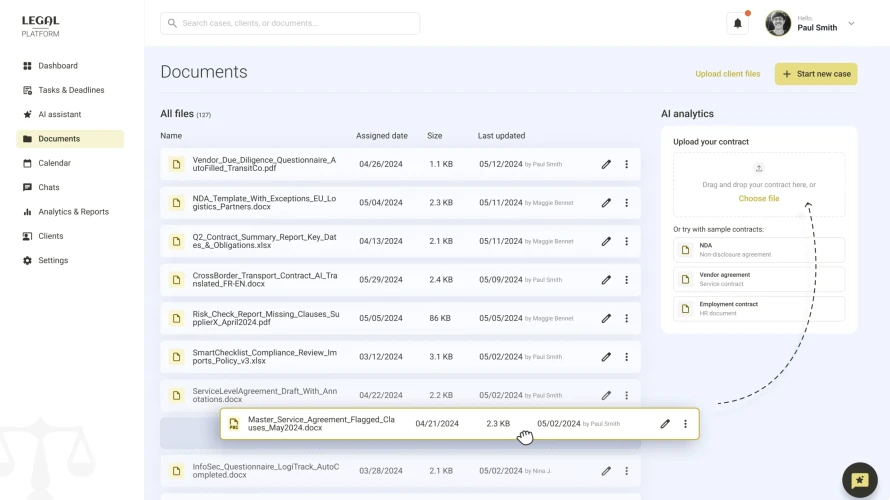
  • AI co-pilot for legal teams with traceable outputs

    A logistics company needed to process contract data faster and reduce manual review.

    We built a co-pilot that extracts key information, analyzes content, and flags potential risks within documents, supported by an architecture that ensures traceability and consistent output validation.

    Key results:

    • 60% reduction in review time
    • 90% accuracy in risk detection
    • 50% faster legal workflows
    Explore project
    Slide 0: Preview of project 1
    Slide 0: Image of project 2
  • AI-powered vehicle inspection system with real-time processing

    A UK technology company developing inspection systems for automotive manufacturers needed higher accuracy and stable performance.

    We improved the machine learning pipeline and redesigned parts of the system architecture to support real-time processing and consistent performance under load.

    Key results:

    • 95% inspection coverage per vehicle
    • 50% reduction in detection errors
    • Faster and more stable processing
    Explore project
    Slide 1: Preview of project 1
    Slide 1: Image of project 2
  • AI platform for employee training with adaptive assessment

    A US manufacturing company needed a consistent way to train and assess employees across multiple locations. We developed an AI-based system with a modular architecture that supports adaptive learning, real-time testing adjustments, and integration with internal platforms.

    Key results:

    • 67% reduction in instructor workload
    • Up to 2× return on training investment
    • 25% decrease in employee turnover
    Explore project
    Slide 2: Preview of project 1
    Slide 2: Image of project 2
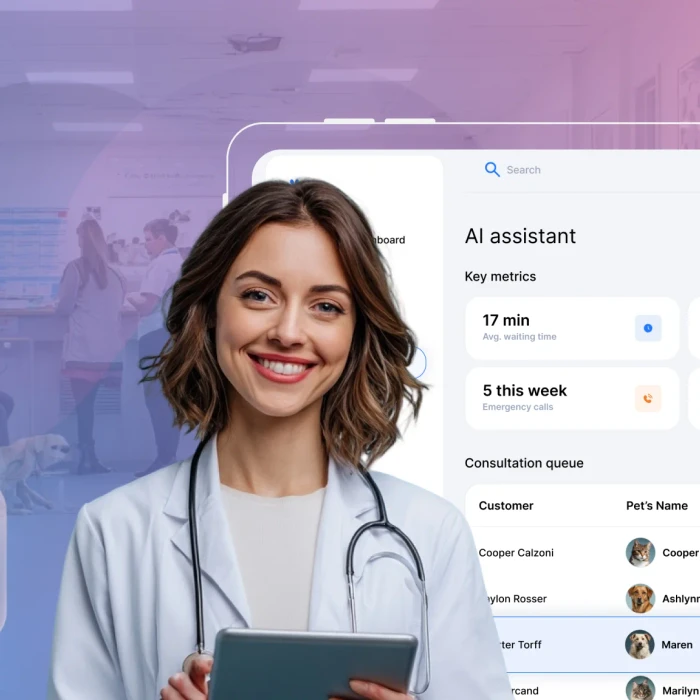
  • AI assistant for veterinary workflows with real-time decision support

    A network of veterinary clinics required more consistent and faster preparation for complex procedures.

    We designed a system that processes patient data and provides real-time guidance, supported by an architecture that ensures reliable data flow and consistent recommendations.

    Key results:

    • 90%+ accuracy in dosage calculations
    • 30% reduction in preparation time
    • 24% increase in team productivity
    Explore project
    Slide 3: Preview of project 1
    Slide 3: Image of project 2
  • AI-driven ground handling intelligence solution for a leading logistics provider

    Our team conducted a data readiness assessment, built scalable ingestion pipelines, consolidated 100M+ operational records, and launched a pilot AI model for predicting flight delay.

    Key results:

    • 200+ engineered time-series features per turnaround
    • 100M+ event records consolidated into an enterprise-grade AI-ready dataset
    • >95% event-to-flight mapping accuracy
    Explore project
    Slide 4: Preview of project 1
    Slide 4: Image of project 2

Our approach to AI system architecture

Our work follows a consistent approach across projects. Each step defines and validates a part of the system before moving forward.

  • Step 1. Define system architecture

    We define system boundaries, services, and integration points across data, models, and applications.

    This ensures the system has a clear structure before implementation begins.

  • Step 2. Design workflows and orchestration

    We map how inputs move through the system, from decision logic to multi-step pipelines and human interaction.

    This defines how the system produces and acts on outputs.

  • Step 3. Structure data and context

    We design data pipelines, retrieval mechanisms, and context handling.

    This ensures the model operates on relevant and up-to-date information.

  • Step 4. Define evaluation and governance

    We implement validation pipelines, access control, and audit mechanisms.

    This ensures outputs can be measured, reviewed, and trusted.

  • Step 5. Ensure reliability and performance

    We design monitoring, scaling strategies, and cost control mechanisms.

    This ensures the system performs consistently under real conditions.

Why teams choose to work with us

Because strong teams build better results. Ours stays involved, accountable, and focused on outcomes.

  • Icon of card 1

    Deep industry expertise

    6+ years of AI and DS experience across various industries, applying AI data strategies that work in real-world business contexts.

  • Icon of card 2

    Security & compliance

    Frameworks aligned with the EU AI Act, HIPAA, SOC 2, and GDPR to ensure responsible and secure AI adoption.

  • Icon of card 3

    Expert and committed team

    95% hold BSs, MScs, or PhDs, and 86% have 5+ years with us – a cohesive team combining vast expertise with proven collaboration.

  • Icon of card 4

    Long-term partnership

    A trusted ally that guides your AI initiatives end-to-end, turning concepts into practical, high-impact solutions beyond just execution.

  • Icon of card 5

    Project accelerators

    Fast-track AI adoption with proven frameworks, templates, and tools that deliver measurable business outcomes.

  • Icon of card 6

    In-house AI R&D department

    Hands-on research and testing that bridges technical possibilities with business goals, reducing uncertainty before full-scale development.

What our clients say

Don’t just take our word for it – hear directly from our clients. Here are some testimonials from our partners who relied on our educational software development services.

Have an AI system in place?

We can evaluate how it performs under real conditions and where it can be improved.

Frequently Asked Questions

Yes. Most of our work involves systems that are already deployed. We analyze current limitations, then redesign specific parts without requiring a full rebuild.

The decision is based on how much of the problem is model-related versus system-related.

We start by evaluating model performance in context, not in isolation. This includes checking input quality, prompt or feature design, consistency of outputs, and how results are used in workflows. In many cases, issues attributed to the model are caused by missing context, poor data handling, or unclear evaluation criteria.

If the model performs adequately with proper inputs and constraints, we keep it and redesign the surrounding system. This may include adding retrieval mechanisms, restructuring prompts, or introducing validation layers.

If the model cannot meet accuracy or latency requirements even under correct conditions, we replace or combine it with alternatives, such as smaller specialized models, ensemble approaches, or routing strategies.

At the model level, we create test datasets that reflect real use cases, including edge cases and known failure scenarios. We define task-specific metrics such as accuracy, precision, recall, or domain-specific scoring methods. For generative systems, we combine automated checks with structured human evaluation where needed.

At the system level, we track how outputs behave in workflows. This includes measuring consistency across repeated inputs, monitoring failure cases, and analyzing how errors propagate through downstream processes. We also implement continuous evaluation pipelines, where new data is sampled, tested, and compared against expected outcomes.

In production, we monitor drift, performance changes, and anomaly patterns over time. This allows us to detect when the system degrades and requires adjustment.

We address data issues at multiple points in the system, not only at ingestion.

First, we analyze data sources to understand gaps, inconsistencies, and update frequency. Based on this, we define validation rules and transformation steps to standardize inputs before they reach the model. This includes schema enforcement, normalization, and filtering of unreliable records.

Second, we design fallback strategies for missing or low-quality data. This may include retrieving additional context from alternative sources, using default values where appropriate, or adjusting workflows to handle uncertainty explicitly.

Third, we redesign how data is accessed and used. For example, introducing retrieval systems that select relevant context at runtime instead of relying on static inputs. Where necessary, we also define changes in data collection processes to improve quality over time.

We use third-party cookies to improve your experience with aristeksystems.com and enhance our services. Click either 'Accept' or 'Manage' to proceed.