

Aristek SystemsContact Us
background image
background image

Agentic AI systems development

Not just agents that respond. Systems that plan, act, and improve over time.

We build AI systems that execute multi-step decisions, interact with your tools, and maintain context across workflows. Each solution is designed for reliable operation, not one-off outputs.

5+

years of AI expertise

40+

clients worldwide

160+

in-house employees

Icon of Certificate 1Icon of Certificate 2Icon of Certificate 3Icon of Certificate 4Icon of Certificate 5Icon of Certificate 6Icon of Certificate 7

Why AI agents, and why now?

Image
33%

of enterprise software applications will include agentic AI by 2028.

15%

of day-to-day work decisions will be made autonomously by AI agents by 2028.

64%

McKinsey survey respondents say agentic AI is enabling their innovation. 39% of them report EBIT impact at the enterprise level.

$139.19 Bn

is the projected cost of the global agentic AI market by 2034. The current cost is $9.14 billion (2026). (Fortune Business Insights)

Agentic AI only works with the right system design

Building an AI agent is not the hard part. Most issues appear when the agent moves beyond a single prompt and becomes part of a working system.

Where things start to break

AI agents struggle when they need to:

  • Maintain state across interactions
  • Execute multi-step decisions in sequence
  • Call tools, APIs, and external systems
  • Handle partial failures and edge cases
  • Adapt to changing inputs and conditions
  • Keep response time and cost under control
  • Adjust to new rules, data, and workflows
What this leads to in real work

When these challenges are not addressed:

  • Weak execution design results in incomplete or broken workflows
  • Poor integration leads to disconnected systems and manual workarounds
  • Missing validation produces unreliable or inconsistent outputs
  • Lack of control creates unpredictable agent behavior
  • No optimization increases latency and operational cost

How we build AI agentic systems

First, we treat an AI agent as a system that executes tasks, not a tool that generates responses.

It must handle context, decisions, and integrations without breaking under real workloads. This shapes how we design every solution.

  • Icon of card 1

    What defines a working system

    Most AI tools are built around isolated interactions. However, production systems require more:

    • Multi-step reasoning
    • Stateful workflows
    • Tool and API usage
    • Decision loops
    • Feedback and correction
  • Icon of card 2

    How we build it

    We define how the system operates before we build it:

    • Break tasks into clear steps
    • Connect to required systems and data
    • Store and reuse context
    • Apply decision rules
    • Add evaluation at key points
  • Icon of card 3

    What you get in practice

    • Tasks are completed from start to finish without manual stitching
    • Fewer handoffs between systems and teams
    • Decisions follow defined logic across multiple steps
    • Automation remains predictable under different conditions
    • The system improves over time through measured feedback
  • Most problems appear after the first demo, when the agent has to run inside a real workflow.

    We focus on how it behaves over time, how it follows steps, uses tools, and handles imperfect inputs, because that is where reliability is decided.

    RuslanCCO
    Photo of author
  • An agent alone does not complete a task, it needs a clear structure around it. That’s why we define how decisions are made, in what order actions happen, and what the system should do when something does not go as expected.

    AlekseiCTO
    Photo of author
  • Consistency comes from structure, not from the model itself. We design how the system tracks context, follows predefined steps, and produces outputs that can be checked and explained later.

    ViktoryiaData Science Expert
    Photo of author
  • A system is only ready when it can handle real conditions without breaking. We build in validation, fallback logic, and control over actions, so the agent remains predictable and every step can be traced if needed.

    SiarheiHead of Back-end
    Photo of author

Our AI agent development services

We structure delivery into clear stages. Each stage defines how the system behaves, then builds on it, and improves it over time.

  • Starter

    Design how the system will act

    What we do

    • Identify use cases for agentic execution
    • Design execution flows (multi-step logic)
    • Define system components (planner, executor, memory)
    • Map integrations and constraints


    Outcome

    • System architecture focused on execution
    • Defined workflows and decision paths
    • Integration map across APIs and tools
    • Identified risks with mitigation approach
    • Implementation roadmap with timelines


    Timeline: 4–6 weeks

  • Build & Integrate

    Make the system run in real environments

    What we do

    • Build execution logic and core components
    • Implement state and memory
    • Integrate APIs, data, and tools
    • Add validation and control mechanisms
    • Set up feedback and evaluation
    • Improve failure handling
    • Configure access and permissions


    Outcome

    • Working system that executes tasks end-to-end
    • Connected workflows across systems
    • Stable state and execution logic
    • Validation and safety mechanisms in place
    • Monitoring, logs, and evaluation metrics
    • Controlled access and traceable actions


    Timeline: 6–10 weeks

  • Optimize & Scale

    Improve performance and adapt over time

    What we do

    • Optimize cost and response time (routing, caching)
    • Refine workflows based on real usage data
    • Extend system across teams and use cases
    • Update models, logic, and integrations as needed

    Outcome

    • Reduced cost and stable performance
    • Workflows adjusted to actual usage patterns
    • System scaled across teams and processes
    • Continuous updates without breaking existing logic


    Timeline: 8+ weeks / ongoing

How much would it cost to build an AI agent?

Use our free online cost calculator to learn the price.

Success stories from our clients

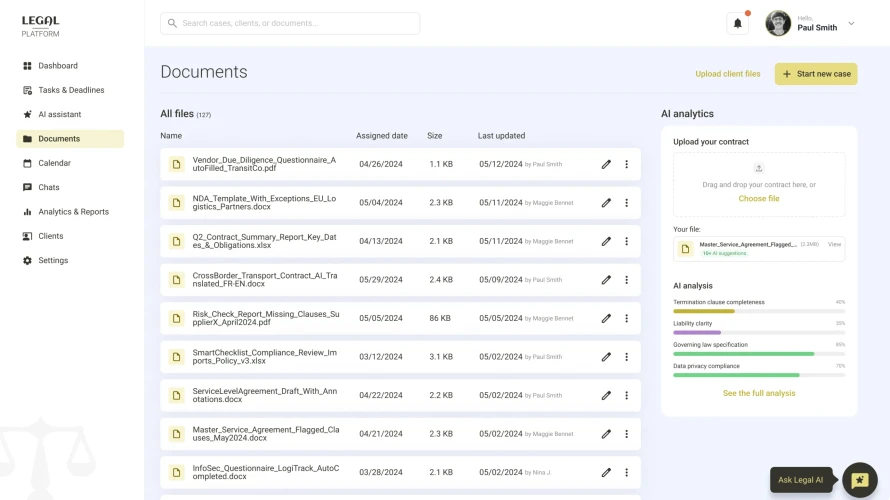
  • AI co-pilot for legal teams with traceable outputs

    A logistics company needed to process contract data faster and reduce manual review.

    We built a co-pilot that extracts key information, analyzes content, and flags potential risks within documents, supported by an architecture that ensures traceability and consistent output validation.

    Key results:

    • 60% reduction in review time
    • 90% accuracy in risk detection
    • 50% faster legal workflows
    Explore project
    Slide 0: Preview of project 1
    Slide 0: Image of project 2
  • AI-powered vehicle inspection system with real-time processing

    A UK technology company developing inspection systems for automotive manufacturers needed higher accuracy and stable performance.

    We improved the machine learning pipeline and redesigned parts of the system architecture to support real-time processing and consistent performance under load.

    Key results:

    • 95% inspection coverage per vehicle
    • 50% reduction in detection errors
    • Faster and more stable processing
    Explore project
    Slide 1: Preview of project 1
    Slide 1: Image of project 2
  • AI co-pilot for veterinary medical records

    Our team developed a smart AI co-pilot that functions as an add-on to the customer’s medical record system, enhancing efficiency and decision-making for veterinarians. Key results:

    • 40% less time spent on medical records review
    • 25% increase in early detection of health issues
    • 30% reduction in diagnostic errors
    Explore project
    Slide 2: Preview of project 1
    Slide 2: Image of project 2
  • AI assistant for analytical dashboards

    Aristek built an AI assistant for analytical dashboards for a US logistics company. Our tool enables better and faster decision-making, decreases managers workload, and allows for resources, processes and strategy optimization. Key results:

    • 90% and more accuracy in interpreting user queries
    • 50% faster insight generation
    • 40% increase in dashboard active users
    Explore project
    Slide 3: Preview of project 1
    Slide 3: Image of project 2
  • Custom AI certification coach

    A global certification provider turned to us to integrate AI into their learning platform. The assistant creates personalized study plans, provides instant help, and increases learner engagement.

    Key results:

    • 89% higher learner satisfaction rate
    • 27% fewer support requests
    • 32% more completed study plans
      Learn more
    Explore project
    Slide 4: Preview of project 1
    Slide 4: Image of project 2

What AI agents we build

AI agents can be of any type. Our team builds agents for every business case, target audience, and level of complexity.

  • By human involvement

    • Copilots

      These agents work side by side with people. They suggest, assist, and complete tasks based on input.

    • Autonomous agents

      Designed to act without constant supervision. These agents follow goals, make decisions, and learn from feedback.

  • By task

    • Automation agents

      These agents take care of routine operations: data entry, email replies, report generation, and more.

    • Decision-making agents

      Built to analyze data, weigh options, and suggest or make informed decisions.

  • By number of agents

    • Single-agent systems

      Perfect for focused tasks, like scheduling meetings or answering support questions.

    • Multi-agent systems

      Coordinate several agents that each handle a part of a larger process, working together, sharing data, and solving complex challenges more efficiently.

  • By target audience

    • Customer-facing agents

      Chatbots, voice assistants, or help desk bots that talk directly to your clients, handling requests, answer questions, and improve user experience without the wait time.

    • Employee-facing agents

      Built to support internal teams, making day-to-day work easier and more efficient.

Why companies trust us to build their agentic AI

We focus on controlled execution, not experimental prototypes. Each system is designed with clear rules, security boundaries, and engineering discipline from the start.

  • Our team has strong technical backgrounds

    95% of our experts have BS, MSc, or PhDs. 88% are Middle or Senior level. 87% have stayed with us for over five years – and that consistency shows in our work.

  • We have our own AI-focused R&D lab

    Our research team tests early ideas, reduces development risks, and helps us launch solutions faster so your business sees value sooner.

  • Security and governance built in

    We define access control, permissions, and audit logs at the system level.
    Every action is traceable and aligned with defined execution rules.

  • Compliance with global standards

    We follow GDPR, CCPA, HIPAA, WCAG, OWASP, and X12 requirements.
    We are ISO 9001 certified and design systems to meet regulatory constraints from the start.

Technologies we use

Recognize, track, and classify objects with top-notch technologies and tools.

AI Platform
Amazon Lex
Amazon Polly
Amazon SageMaker
Amazon Transcribe
Azure Cognitive Search
Azure Machine Learning
Databricks
Core ML
Create ML
Detectron2
Hugging face
Keras
OpenCV
Prophet
PySpark
PyTorch
scikit-learn
TensorFlow
Amazon Redshift
Cassandra
ClickHouse
Microsoft SQL Server
MySQL
Oracle
PostgreSQL
Snowflake

Your business has tasks. We build agents that handle them.

Frequently Asked Questions

Agentic AI development services focus on building systems that can plan, decide, and execute tasks across workflows. These systems do more than generate responses. They interact with tools, follow defined steps, and complete tasks from start to finish.

In practice, agentic AI software development includes designing execution logic, integrating data sources, and defining how decisions are made. As an agentic AI company, we structure these systems so they operate reliably under real conditions, not just in isolated interactions.

The cost depends on how complex the system needs to be. A simple setup with limited integrations and short workflows requires less effort than a system that manages multi-step execution across several tools and data sources.

In most cases, pricing is defined after a discovery phase. During this stage, we assess workflows, integrations, and control requirements. This approach is common in agentic AI consulting, where estimates are based on actual system design rather than assumptions.

Several technical factors define the final cost. The most important are the number of integrations, the complexity of decision logic, and the level of validation required.

For example, enterprise agentic AI systems often require strict access control, monitoring, and auditability, which increases development effort. Projects that involve custom agentic AI solutions may also require additional work on workflow design, state management, and performance optimization.

Agentic AI is most useful in industries where processes involve multiple steps, systems, and decisions. This includes healthcare, logistics, retail, finance, and education.

In these environments, agentic AI for business helps automate structured workflows such as request handling, reporting, and coordination between systems. Many companies adopt agentic AI solutions to reduce manual work and improve consistency across operations.

Autonomous AI agents are suited for tasks that follow defined rules and require interaction with data or systems. Examples include processing support tickets, generating reports, handling internal requests, and updating records across platforms.

Through agentic AI automation, these tasks are executed as step-by-step workflows. The system tracks progress, applies rules, and completes actions without constant manual input.

Agentic AI systems are built around specific workflows, data structures, and business rules. This allows them to reflect how a company operates rather than forcing a standard pattern.

With custom agentic AI solutions, we define execution logic, integrations, and decision paths based on actual use cases. This level of customization is typically delivered through agentic AI consulting, where system behavior is planned before development begins.

Integration depends on the systems already in use. Most projects involve connecting APIs, databases, and internal tools so the agent can access and update data as part of its workflow.

In agentic AI software development, integration is treated as part of the system design, not a separate step. As an agentic AI company, we ensure that agents operate within existing environments with defined access, validation, and monitoring in place.

We use third-party cookies to improve your experience with aristeksystems.com and enhance our services. Click either 'Accept' or 'Manage' to proceed.