

Aristek SystemsContact Us
background image
background image

Generative AI development services

We build and implement gen AI solutions that operate as part of production environments to reduce manual operations, improve response consistency, and support scalable execution.

6+

years of AI experience

23+

years in tech

40+

clients worldwide

Icon of Certificate 1Icon of Certificate 2Icon of Certificate 3Icon of Certificate 4Icon of Certificate 5Icon of Certificate 6Icon of Certificate 7Icon of Certificate 8Icon of Certificate 9

Generative AI is already part of how companies operate

92%

of Fortune 500 companies use generative AI
(Financial Times)

12%

Return on investment for early adopters of generative AI (Deloitte)

5.4%

of work hours saved each week by workers using gen AI, which equals to a 33% productivity gain for each hour. (McKinsey)

Image 1
Image 2
Image 3

However, >90% of gen AI pilots are failing

– reported by Fortune. What sabotages the gen AI success is a structural mismatch between how a pilot is built and what a production system requires.

  • AI challenges

    AI generates code ≠ Maintains a coherent system over time

    AI builds a prototype ≠ Owns tradeoffs and architecture decisions

    AI accelerates development ≠ Ensures compliance, auditability, SLA

    AI impresses in a demo ≠ Survives production load and latency constraints

  • What production requires

    • Structured and filtered input handling
    • Output validation before use
    • Controlled request handling under load
    • Stable integrations with fallback paths
    • Logging of prompts and system actions
    • Defined fallback for invalid responses
  • How we ensure it survives production

    • Architecture documented before engineering begins
    • Integration scoped as core work, not a final step
    • Output validation built into the pipeline, not added afterward
    • Explicit fallback for every failure path
    • Observability configured before launch
    • Documentation written for whoever owns it next

How we can help

Each service is scoped to a specific phase of GenAI implementation, from initial architecture through production operations.

  • GenAI system architecture

    “We have a working PoC. Now we need to decide what we’re actually building.”

    • Model selection based on use case and constraints
    • RAG or prompt-based architecture decisions
    • Prompt flow design and orchestration
    • Caching and latency control
    • Data flow design aligned with production needs
  • Enterprise integration

    “AI that cannot talk to your systems is a standalone tool, not a solution.”

    • Integration with ERP, CRM, and internal APIs
    • Authentication and access control setup
    • Document and data pipeline connections
    • Contract definition between systems and AI layer
    • Secure data exchange design
  • AI output governance

    “Useful output and auditable output are not the same requirement”

    • Output validation rules and schema enforcement
    • Audit logging for AI decisions and responses
    • PII filtering and sensitive data handling
    • Moderation and safety checks before delivery
    • Routing logic for approved vs rejected outputs
  • Fine-tuning & RAG pipelines

    “The base model doesn’t know our domain well enough to be useful.”

    • Evaluation of fine-tuning vs RAG approach
    • Knowledge base structuring and indexing
    • Retrieval pipeline design and tuning
    • Model performance testing on domain data
    • Maintenance strategy for long-term stability
  • Deployment & monitoring

    “A system without observability is a system you are managing blind.”

    • Token usage and cost tracking
    • Latency and performance monitoring
    • Output quality measurement
    • Alerting for regressions and anomalies
    • Production health dashboards
  • Production readiness audit

    “We need someone to tell us what we’re missing before we scale this.”

    • Architecture and pipeline review
    • Security and access control assessment
    • Cost and scalability analysis
    • Data flow and integration check
    • Prioritized improvement plan with risks identified

Our AI projects that survived contact with production

  • AI-powered content generator for knowledge assessment

    Discover how we developed an AI-powered content generator for knowledge assessment, helping our client

    • Save 90% in quiz creation time
    • Achieve a +4 point increase in NPS
    • And boost conversion rates by 27%!
    Explore project
    Slide 0: Preview of project 1
    Slide 0: Image of project 2
  • AI co-pilot for legal teams with traceable outputs

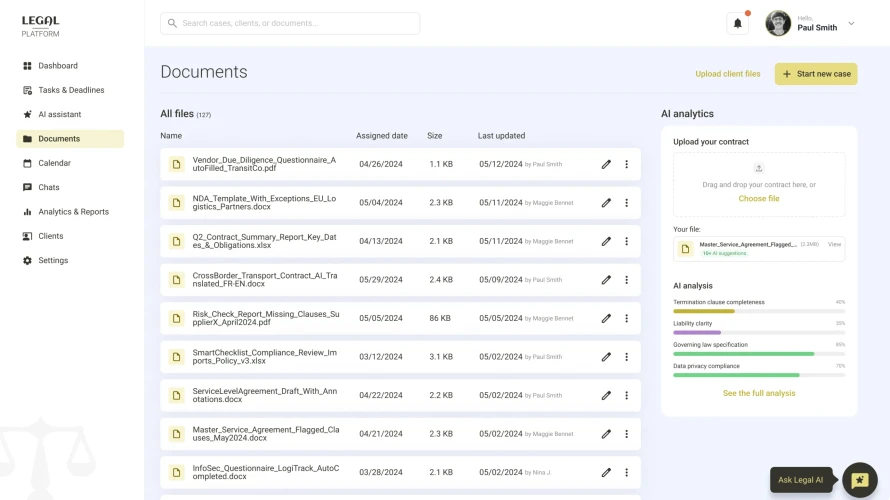
    A logistics company needed to process contract data faster and reduce manual review. We built a co-pilot that extracts key information, analyzes content, and flags potential risks within documents, supported by an architecture that ensures traceability and consistent output validation.

    Key results:

    • 60% reduction in review time
    • 90% accuracy in risk detection
    • 50% faster legal workflows
    Explore project
    Slide 1: Preview of project 1
    Slide 1: Image of project 2
  • Custom AI coach for certification prep

    The global certification provider partnered with Aristek to incorporate AI capabilities into their digital prep platform and make the learning process more accessible, personalized, and effective.

    • 89% boost in learner satisfaction
    • 27% drop in support tickets
    • 32% increase in completion of study plans
    Explore project
    Slide 2: Preview of project 1
    Slide 2: Image of project 2
  • AI co-pilot for veterinary medical records

    Our team developed a smart AI co-pilot that functions as an add-on to the customer’s medical record system, enhancing efficiency and decision-making for veterinarians. Key results:

    • 40% less time spent on medical records review
    • 25% increase in early detection of health issues
    • 30% reduction in diagnostic errors
    Explore project
    Slide 3: Preview of project 1
    Slide 3: Image of project 2
  • AI assistant for analytical dashboards

    Aristek built an AI assistant for analytical dashboards for a US logistics company. Our tool enables better and faster decision-making, decreases managers workload, and allows for resources, processes and strategy optimization. Key results:

    • 90% and more accuracy in interpreting user queries
    • 50% faster insight generation
    • 40% increase in dashboard active users
    Explore project
    Slide 4: Preview of project 1
    Slide 4: Image of project 2

Not every business problem is the right fit for generative AI. Some are. Some are better served by simpler automation.

We will tell you which category yours falls into.

We choose models based on your system needs

Our team works across the major model families. Choice is determined by your constraints, not ours.

  • Icon of card 1

    Large Language Models (e.g., OpenAI, Anthropic Claude 3, etc.)

    Used when reasoning, generation, or interpretation is central to the workflow

  • Icon of card 2

    Open-source models (e.g., LLaMA, Mistral)

    Used when control, cost predictability, or on-prem deployment is required

  • Icon of card 3

    Embedding models & vector databases

    Used for retrieval, context injection, and grounding outputs in internal data

  • Icon of card 4

    Orchestration frameworks

    Used to coordinate multi-step workflows and control execution paths

A process designed around what goes wrong after the demo

We design and build generative AI systems with clear structure and controlled behavior. Here is how we do it:

  • Step 1. Discovery & architecture review

    Your team + our architects

    We map your current state: what exists, what’s planned, what the production environment looks like, and where the known risks are.

    This includes data sources, integration points, compliance requirements, and the user journeys the system needs to support.

  • Step 2. System design

    Our architects + your product and engineering leads

    Full system design: model selection, orchestration framework, retrieval architecture, API contracts, data pipeline design, and the governance layer.

    Every major decision is documented with rationale and alternatives considered.

  • Step 3. Build & integration

    Our engineering team

    Implementation against the system design. We embed with your team or operate standalone depending on context.

    All code is reviewed against the architecture spec – deviations require explicit sign-off, not informal workarounds.

  • Step 4. Production hardening

    Our engineering + your operations team

    Load testing against realistic concurrency profiles. Failure injection. Latency profiling under production-representative data volumes.

    Observability configuration and alerting calibration. Documentation of operational procedures.

  • Step 5. Launch & stabilization

    On-call support included

    Staged rollout with defined rollback criteria. Active monitoring for the first 30 days. Any issues that surface get root-cause analysis, not patches.

    Handoff documentation is written for the team that will own this system, not for us to stay involved.

Why companies choose Aristek for gen AI development

We don’t hand off a system and disappear. We sign off on architecture decisions, production readiness, and operational handoffs – and we put that in writing. This shapes how we work.

  • Icon of card 1

    AI expertise across complex industries

    More than 6 years of experience in AI and data science across healthcare, manufacturing, logistics, education, and enterprise platforms.

  • Icon of card 2

    Experienced engineering teams

    95% of specialists hold BS, MSc, or PhD degrees. 86% have worked together for more than 5 years.

  • Icon of card 3

    Security and compliance built into system design

    System design aligned with GDPR, HIPAA, SOC 2, and the EU AI Act, including audit logging and controlled data access.

  • Icon of card 4

    Production-focused system design

    Validation logic, fallback handling, monitoring, and request control designed for real operating conditions.

  • Icon of card 5

    In-house AI R&D

    Internal research and testing of models, orchestration methods, and infrastructure approaches before production rollout.

  • Icon of card 6

    Accelerators for faster implementation

    Reusable frameworks and delivery patterns that reduce implementation time and deployment risk.

Where generative AI can be applied in real systems

Generative AI is applied to tasks that involve language, documents, and variable input. The use cases below reflect where it is already used in production systems.

  • EdTech

    • Generate course materials based on curriculum structure
    • Evaluate open-text answers using predefined scoring criteria
    • Provide step-by-step explanations for problem solving
    • Adapt content difficulty based on user performance
    • Process and summarize student feedback
  • Veterinary & healthcare

    • Generate clinical notes from consultation transcripts
    • Summarize patient records for faster review
    • Extract structured data from medical documents
    • Assist with diagnostic suggestions based on symptoms
    • Automate responses to standard patient inquiries
  • Legal

    • Review contracts and flag missing or risky clauses
    • Summarize legal documents and case files
    • Extract key terms and obligations from agreements
    • Generate first drafts of legal documents
    • Search and retrieve relevant case law from large datasets
  • Software development

    • Generate code snippets based on functional requirements
    • Assist in code review by identifying inconsistencies and potential errors
    • Create technical documentation from source code and comments
    • Convert legacy code into modern languages or frameworks
    • Generate test cases based on application logic
    • Summarize pull requests and change logs
  • Retail

    • Generate product descriptions from structured attributes
    • Automate customer support responses
    • Analyze customer reviews for common issues
    • Personalize recommendations based on behavior
    • Forecast demand using historical and external data
  • Manufacturing

    • Generate and update technical manuals
    • Summarize maintenance logs and incident reports
    • Assist operators with step-by-step instructions
    • Extract data from equipment reports
    • Support quality control through anomaly detection descriptions

Will your GenAI solution survive production?

We help build systems that do.

As a generative AI services provider, we define how data enters, moves through, and exits the system. Sensitive data is filtered or masked before it reaches any generative AI model. We also implement access controls, encryption, and audit logs.

For regulated environments, we align system behavior with compliance requirements such as GDPR or HIPAA. Every interaction, including prompts and outputs, can be traced and reviewed.

The cost of generative AI development services depends on system scope, not just development time. Key factors include model usage, infrastructure, integration complexity, and required performance levels.

For example, systems using multiple AI models with real-time response requirements will have higher operational costs than batch-processing workflows. We break down costs by component so you can track spending across the system.

A generative AI development company does not require fully structured data at the start, but data flows must be defined. You need to know what data is used, where it comes from, and how it should be processed.

We help structure inputs, remove inconsistencies, and prepare datasets for machine learning and generative tasks. This includes defining how internal data is combined with external sources.

Success in generative AI development solutions is measured through system-level metrics. These include response accuracy under real inputs, latency, failure rates, and cost per request.

We also evaluate how well the system supports the defined business objective, such as reducing manual review or improving response time in customer workflows.

Yes. As a gen AI development company, we monitor system performance after deployment. This includes tracking output quality, latency, and system usage.

We adjust validation rules, update models, and refine workflows based on real usage data. This ensures the system remains stable as input patterns and workloads change.

Gen AI development services are suitable when inputs are unstructured or variable, such as text, documents, or user queries. Traditional automation works better for fixed, rule-based processes.

For example, AI powered systems can interpret language or generate responses, while rule-based systems execute predefined logic. The choice depends on the type of task, not the technology trend.

Yes. We offer custom generative AI development services tailored to industry-specific workflows and constraints.

This includes adapting language models to domain terminology, integrating with existing AI systems, and aligning outputs with operational requirements such as compliance or reporting.

Yes. Custom gen AI development focuses on integrating generative models into multi-component systems.

We design how artificial intelligence interacts with databases, APIs, and user interfaces. This includes orchestration logic, validation layers, and seamless integration with existing services.

Yes. You can hire gen AI developers to work alongside your internal engineers.

They support tasks such as integrating generative AI solutions, optimizing workflows, and implementing predictive analytics where needed. This model works well when you already have an internal system in place.

A generative AI development company should take responsibility for system behavior, not just model output.

This includes designing architecture, managing integrations, and ensuring that customer experiences remain consistent under real conditions. The focus should be on how the system performs after deployment, not just during testing.

Explore other AI services

  • Icon of card 1

    AI chatbot development

    Development of AI chatbots for customer support, internal knowledge access, onboarding, and conversational workflows.

  • Icon of card 2

    AI agent development

    Development of AI agents that execute multi-step tasks, interact with systems, retrieve data, and automate operational processes.

  • Icon of card 3

    AI integration

    Integration of AI models into existing applications, enterprise systems, APIs, and business workflows with defined control and monitoring layers.

  • Icon of card 4

    AI for software development

    Implementation of AI tools for code generation, documentation, test creation, code review, and engineering workflow automation.

We use third-party cookies to improve your experience with aristeksystems.com and enhance our services. Click either 'Accept' or 'Manage' to proceed.