Aristek Systems
Contact Us
background image
background image

AI automation services

We design, develop, and integrate AI automation solutions for companies that need production-ready results: workflow automation, intelligent document processing, agentic AI systems, and full-stack integrations with existing ecosystems.

6+

years of AI development experience

23+

years in tech consulting

40+

clients worldwide

Not every workflow needs AI

But if any of the following challenges sound familiar, AI automation may help improve efficiency and reduce operational overhead.

  • Employees spend hours reviewing documents, emails, forms, or reports.

  • Critical information is scattered across multiple systems and difficult to access quickly.

  • Teams repeatedly perform the same manual steps to complete routine tasks.

  • Business processes depend heavily on copying, validating, or transferring data.

  • Customer requests, tickets, or inquiries continue to grow while response times slow down.

  • Decision-making requires reviewing large volumes of information.

  • Existing automation tools struggle with unstructured data such as text, documents, or conversations.

  • Scaling operations means hiring more people to handle repetitive work.

  • Important knowledge remains locked in documents, databases, or internal systems.

  • Process bottlenecks appear between departments, systems, or approval stages.

What companies gain when repetitive work gets automated

Efficiency gains are easy to promise. These are documented outcomes from published research.

Inventory and logistics costs go down when forecasting is automated

AI-driven demand forecasting reduces inventory levels by 20–30% and cuts logistics costs by 5–20%.
(McKinsey)

Structured data processing becomes faster and more accurate

Automating rule-based workflows cuts error rates by up to 50% and reduces processing time by 25%. (Deloitte, Payroll in Transition)

Financial process automation returns investment within the first year

A study of 247 organizations found a median ROI of 150% within year one of deploying intelligent automation in financial operations. (ResearchGate)

Image 1
Image 2
Image 3

AI automation services we provide

Every automation challenge is different. We help organizations identify, build, and scale AI solutions where they create the greatest business value.

AI solves specific operational problems, not general ones.

Tell us what yours are and we will map where automation applies.

Our featured AI automation projects

These projects represent a cross-section of our AI-powered automation work across retail, legal, analytics, healthcare, and education.

  • AI-based behavior analysis & sales forecast for a giant retailer

    A retailer with over 3 million active customers needed a more effective way to convert large volumes of customer data into accurate sales forecasts. We developed an AI-powered analytics system that automates behavior analysis and delivers forecasting insights directly to planning teams.

    Key figures:

    • 7% increase in visitor-to-buyer conversion rate
    • 15% increase in volume of usable data collected
    • 35% reduction in monthly infrastructure costs
    Explore project
    Slide 0: Preview of project 1
    Slide 0: Image of project 2
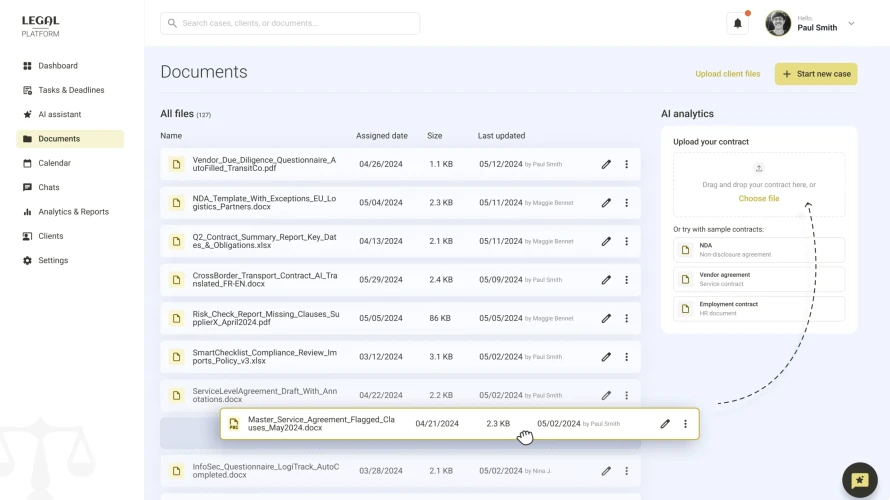
  • Intelligent automation for legal contract review

    Manual contract review was slowing legal operations and creating inconsistencies in risk assessment. We implemented AI-powered contract analysis to automate clause extraction, contract screening, and risk identification, allowing legal specialists to focus on higher-value work.

    Key results:

    • 60% reduction in time spent on routine contract reviews
    • 90% accuracy in risk detection
    • 50% time saved across legal operations overall
    Explore project
    Slide 1: Preview of project 1
    Slide 1: Image of project 2
  • AI for real-time decision-making in analytics

    Business users relied on analysts to retrieve and interpret data, creating delays in decision-making. We built an AI assistant that understands natural language queries and generates actionable insights directly within the analytics platform.

    Key results:

    • Over 90% accuracy in query interpretation
    • Insight generation completed 50% faster
    • 40% increase in active dashboard usage
    Explore project
    Slide 2: Preview of project 1
    Slide 2: Image of project 2
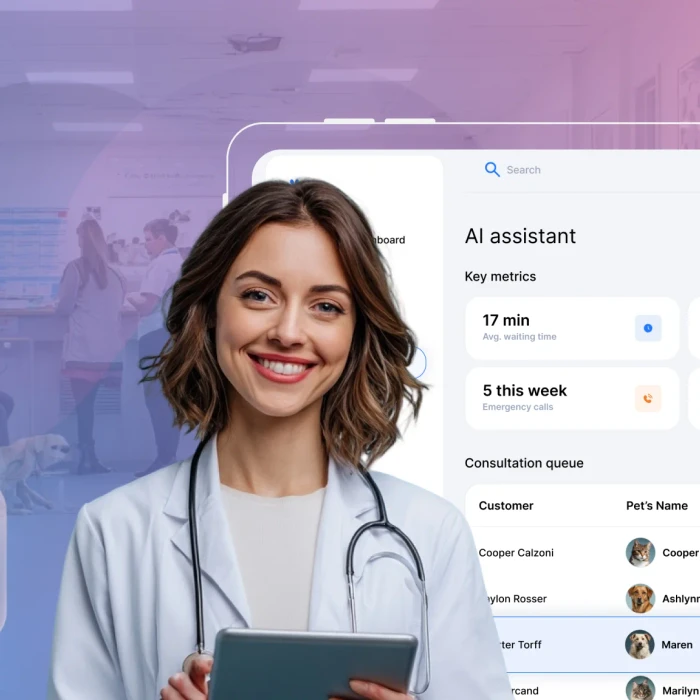
  • Automated clinical workflows for a veterinary surgery network

    Veterinary teams were spending valuable time preparing treatment protocols and surgical documentation. We developed AI-powered clinical workflow automation that provides real-time recommendations and support during patient preparation and care.

    Key results:

    • 90% and more accuracy in anesthesia dosage calculations
    • 30% reduction in surgical prep time
    • 24% increase in vet team productivity
    Explore project
    Slide 3: Preview of project 1
    Slide 3: Image of project 2
  • AI-driven question-answering automation for an eLearning platform

    As the platform grew, providing timely answers to student questions became increasingly difficult. We built an AI-powered question-answering system that delivers instant responses across multiple subject areas and operates around the clock.

    24/ 7 availability for student support;

    >1000 requests per minute handles the system;

    +5 points the customer grew the platform’s NPS.

    Explore project
    Slide 4: Preview of project 1
    Slide 4: Image of project 2

Why companies choose Aristek for AI automation

Building effective AI automation requires more than AI expertise. It requires strong engineering, seamless integrations, and solutions designed around real business processes.

  • Icon of card 1

    Proven experience

    23+ years in software engineering and 6+ years in AI development across enterprise systems, automation platforms, and data-intensive applications.

  • Icon of card 2

    Expert team

    95% of our engineers hold BS, MSc, or PhD degrees, and most have been with Aristek for more than five years.

  • Icon of card 3

    Enterprise system integration

    Experience integrating AI solutions with ERP, CRM, cloud, and legacy systems, including SAP, Salesforce, and Microsoft 365.

  • Icon of card 4

    Scalable architecture by default

    Solutions are designed to support production workloads, growing data volumes, and increasing user demand.

  • Icon of card 5

    Modernization alongside automation

    We introduce AI while modernizing existing systems, avoiding costly full-scale replacements whenever possible.

  • Icon of card 6

    Long-term support

    We do not hand off finished code and exit. Our maintenance and support service means the team that built the system remains available to extend, retrain, and maintain it.

Before scoping a project, most teams want a ballpark.

Use our calculator to estimate the cost of your AI automation project based on scope, complexity, and integrations.

How we approach AI automation projects

We focus on understanding how work actually happens before introducing automation. Each step is designed to reduce uncertainty and ensure the solution fits your systems and operations.

  • Phase 1: Discovery and business analysis

    1–3 weeks | Business analyst, Solution architect, Project manager

    Workshops with your stakeholders to map current processes and identify automation candidates.

    Deliverables: process inventory, prioritized automation opportunities with effort-to-impact scores, project scope document.

  • Phase 2: Architecture and UX design

    1–2 weeks | Solution architect, ML engineer, UX designer

    Technical architecture covering system components, integration points, data flows, and infrastructure requirements.

    For user-facing interfaces: wireframes and a validated design prototype.

  • Phase 3: Development and integrations

    4–16 weeks | ML engineers, backend and frontend developers, DevOps engineer

    Two-week sprints with a working demo at each review. Model training, pipeline development, API integrations, and frontend components run in parallel.

    Integration testing with your target systems starts here, not after development ends.

  • Phase 4: Testing and deployment

    1–3 weeks | QA engineers, DevOps engineer, solution architect

    Unit, integration, load, and adversarial tests on model behavior. Staged rollout with automated rollback.

    Deliverables: test reports, deployment runbooks, configured monitoring dashboard.

  • Phase 5: Support and optimization

    Ongoing | Support engineers, ML engineers

    System performance monitoring, model accuracy tracking, and integration health checks.

    Retraining is scheduled or triggered by detected degradation. SLA-based support with a named technical contact.

Technologies and integrations

Claude 3.5/Opus 4
GPT-4o
Gemini 2.0 Flash
Mistral Large
LLaMA 3.3
Deepseek R2
open-source fine-tuning
LangChain / LangGraph
LlamaIndex
AutoGen
CrewAI
Semantic Kernel
MCP (Model Context Protocol)
OpenAI Assistants API
n8n
Make
UiPath
Zapier
Temporal
Prefect
AWS (Bedrock, SageMaker)
Azure AI Foundry
GCP (Vertex AI)
Cloudflare Workers AI
Python
FastAPI
Node.js
Go
gRPC
Next.js
React
Vue 3
Vercel AI SDK
React Native
Flutter
Pinecone
Weaviate
pgvector
Redis
MongoDB
PostgreSQL
GitHub Actions
Docker
Kubernetes
MLflow
Weights & Biases
ArgoCD
Salesforce
HubSpot
Slack
Jira / Linear
REST / GraphQL
Webhook / Event streaming
Apache Kafka
Image

Bring your case

If you’re not sure where AI would create the most value, we can analyze your workflows and identify practical automation opportunities.

Frequently asked questions

Cost depends on process complexity, required integrations, data availability, and whether custom AI models are needed. Simple automation initiatives require less effort than multi-system workflows. As an AI automation company, we provide a detailed estimate after the discovery phase and before development begins.

AI business automation is most effective for repetitive, information-heavy processes such as document processing, contract review, customer request handling, reporting, compliance checks, and knowledge retrieval. If a process involves reviewing information, extracting data, or making routine decisions, it is often a strong candidate for automation.

Traditional automation follows predefined rules and works best with structured data. AI-driven automation can interpret documents, text, images, and other unstructured inputs, making it suitable for more complex and variable workflows.

Yes. Our AI automation development services cover solution design, implementation, integration, and support. We build custom AI automation solutions tailored to your processes, systems, and business requirements.

Yes. Our intelligent automation services integrate AI solutions with ERP, CRM, HR, finance, customer support, and other business platforms through APIs, databases, and event-driven architectures. We work with both modern cloud platforms and legacy systems.

Organizations with document-heavy, repetitive, or data-intensive processes often see the greatest value from AI-powered automation. Common industries include healthcare, veterinary, legal, logistics, manufacturing, retail, education, and corporate training.

Project timelines depend on complexity and integration requirements. A focused automation initiative may take several weeks, while enterprise AI automation solutions involving multiple systems and workflows typically require several months. Detailed timelines are provided during project planning and estimation.

We use third-party cookies to improve your experience with aristeksystems.com and enhance our services. Click either 'Accept' or 'Manage' to proceed.